KDP Interior Unlined Journal Vol. 33: A Practical Foundation for Low-Content Publishing
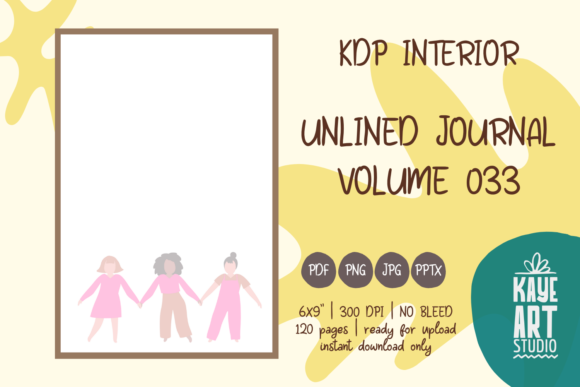
For self-publishers and digital creators, the search for reliable, pre-formatted interiors often feels like a gamble between quality and convenience. KDP Interior Unlined Journal Vol. 33 addresses this specific friction point by offering a tested, professional-grade foundation for low-content books. This isn't just a blank template; it is a production-ready asset designed to streamline the publishing workflow for Amazon KDP. With a standard 6×9 inch trim size and 120 pages of clean, unlined space, this volume serves as a versatile canvas for a wide array of niche publications. The files have been rigorously tested on the KDP platform, ensuring that when you upload your PDF, PNG, JPG, or PPTX file, it passes the automated review process without the dreaded margin or bleed errors that frequently stall new publishers.
Why Unlined Interiors Still Dominate Specific Niches
While lined journals are ubiquitous, there is a distinct and profitable market segment that actively avoids horizontal rules. Understanding where KDP Interior Unlined Journal Vol. 33 fits requires looking at user behavior rather than just product specifications. Unlined paper offers freedom that structured formats cannot provide. For artists, sketchers, and visual thinkers, lines are barriers. For mindfulness practitioners and stream-of-consciousness writers, the absence of structure encourages a more organic flow of thought.
This specific interior capitalizes on the "freewriting" trend popular among entrepreneurs and creatives who use morning pages or brain dumping as a productivity tool. When a user buys an unlined journal, they are often buying permission to be messy, creative, or non-linear. By providing a high-resolution 300 DPI interior with no bleed settings, this resource allows publishers to tap into these psychological needs without spending hours formatting margins in design software. The value lies in the immediate usability; you can focus entirely on creating a compelling cover and marketing strategy because the internal architecture is already solved.
Real-World Applications Across Different Audiences
The versatility of a 120-page unlined format extends far beyond simple diary entries. Different demographics utilize this specific layout for vastly different purposes, and successful publishers tailor their covers and metadata to match these distinct intents.
- Visual Artists and Designers: Many illustrators prefer unlined paper for field sketches or concept art. A 6×9 size is portable enough for travel but large enough for detailed work. Publishers targeting this group might pair this interior with a minimalist, textured cover to create a premium-feeling sketchbook.
- Mental Health and Wellness Advocates: Shadow work, gratitude journaling, and CBT exercises often require space for drawing emotions or mapping thoughts visually. Lines can feel restrictive when processing trauma or complex feelings. An unlined interior signals a safe, open space for emotional exploration.
- Educators and Students: While notebooks are usually lined, unlined journals are essential for mind mapping, diagramming scientific processes, or practicing calligraphy. Language learners also use unlined space to practice character formation (such as Kanji or Mandarin) where standard spacing doesn't apply.
- Dream Journals and Spiritual Practitioners: Dream recall is rarely linear. Users in this niche need space to sketch symbols, write fragmented narratives, and connect ideas spatially across the page. The 120-page count provides roughly four months of daily entries, making it a substantial yet manageable commitment.
- Business Professionals and Strategists: Notetaking during brainstorming sessions or client meetings often involves arrows, circles, and quick diagrams. Bullet journal enthusiasts who prefer a freestyle approach over dotted grids also represent a significant buyer persona for this type of interior.
Navigating Technical Specifications for Seamless Publishing
One of the primary reasons publishers turn to pre-made assets like KDP Interior Unlined Journal Vol. 33 is to avoid technical rejection. Amazon’s printing guidelines are strict, and even minor deviations can result in failed uploads. This interior is configured specifically with no bleed settings. This is a crucial distinction. No bleed means all content must stay within the safe zone, leaving a white margin around the edge of the page. This is generally safer for beginners and ensures text or subtle design elements never get trimmed off during the binding process.
The availability of multiple file types—PNG, PDF, JPG, and PPTX—offers flexibility depending on your workflow. PDF is typically the industry standard for KDP uploads due to its fixed layout and vector-like crispness. However, having PPTX or PNG options allows creators who want to add custom headers, footers, or branding to edit the interior before finalizing. Because the source files are 300 DPI, any modifications you make will retain print-quality sharpness. Blurry interiors are a common cause of negative reviews in the low-content space; starting with a high-resolution base prevents this reputation killer.
Strategic Considerations Before You Publish
Before integrating KDP Interior Unlined Journal Vol. 33 into your catalog, it is important to manage expectations and plan strategically. First and foremost, understand that this listing is for the interior only. Your success depends entirely on your ability to create a cover that communicates the book's purpose. An unlined interior is generic by nature; your cover must do the heavy lifting of differentiation. If you are targeting gardeners, the cover needs botanical illustrations. If you are targeting coders, it needs tech-inspired aesthetics. The interior is the engine, but the cover is the paint job that sells the car.
Additionally, consider the page count relative to your niche. At 120 pages, this journal is lightweight and cost-effective to produce, which allows for competitive pricing. However, some niches expect heft. A comprehensive art portfolio might require 200+ pages, while a travel journal might benefit from being thinner. Analyze the bestsellers in your chosen sub-niche to see if 120 pages aligns with customer expectations. If competitors are consistently offering 8x10 sizes or lined variations, you may need to adjust your keyword strategy to highlight the unique benefits of the compact, unlined format.
Maximizing Value Through Customization and Branding
While the files are ready for upload as-is, the most successful publishers treat KDP Interior Unlined Journal Vol. 33 as a starting point rather than a finished product. Since you receive editable formats, consider adding value to stand out in a saturated marketplace. Adding a simple "This Book Belongs To" page, a table of contents, or numbered pages can transform a generic notebook into a specialized tool. Even small touches like a subtle logo on the bottom corner of each page can build brand recognition across multiple volumes.
Furthermore, think about how this interior pairs with other products. If you sell digital planners or printable worksheets, this physical journal can serve as a companion product. Educators could bundle this with a curriculum guide; therapists could recommend it alongside a workbook. The unlined nature makes it an excellent supplementary tool because it adapts to whatever primary resource the user is engaging with. By viewing this interior as part of a larger ecosystem rather than a standalone commodity, you increase both perceived value and customer lifetime value.
Ensuring Long-Term Success with Quality Assets
In the world of KDP publishing, consistency builds trust. Using tested, high-quality interiors like Vol. 33 ensures that every book you publish meets a baseline standard of professionalism. Customers who have a good experience with the paper quality and formatting of one of your journals are more likely to return for another. Conversely, a single bad experience with bleeding ink or cut-off margins can lead to returns and account warnings.
Ultimately, KDP Interior Unlined Journal Vol. 33 represents a balance of efficiency and quality. It removes the technical barriers to entry while providing a flexible foundation for creative expression. Whether you are a seasoned publisher scaling your catalog or a first-time creator testing the waters, having a reliable, pre-tested interior allows you to focus your energy where it matters most: understanding your audience, designing beautiful covers, and building a sustainable publishing business. The tool itself is simple, but the opportunities it unlocks for serving specific user needs are vast and varied.